What Is a Travel Adapter? A Simple Guide
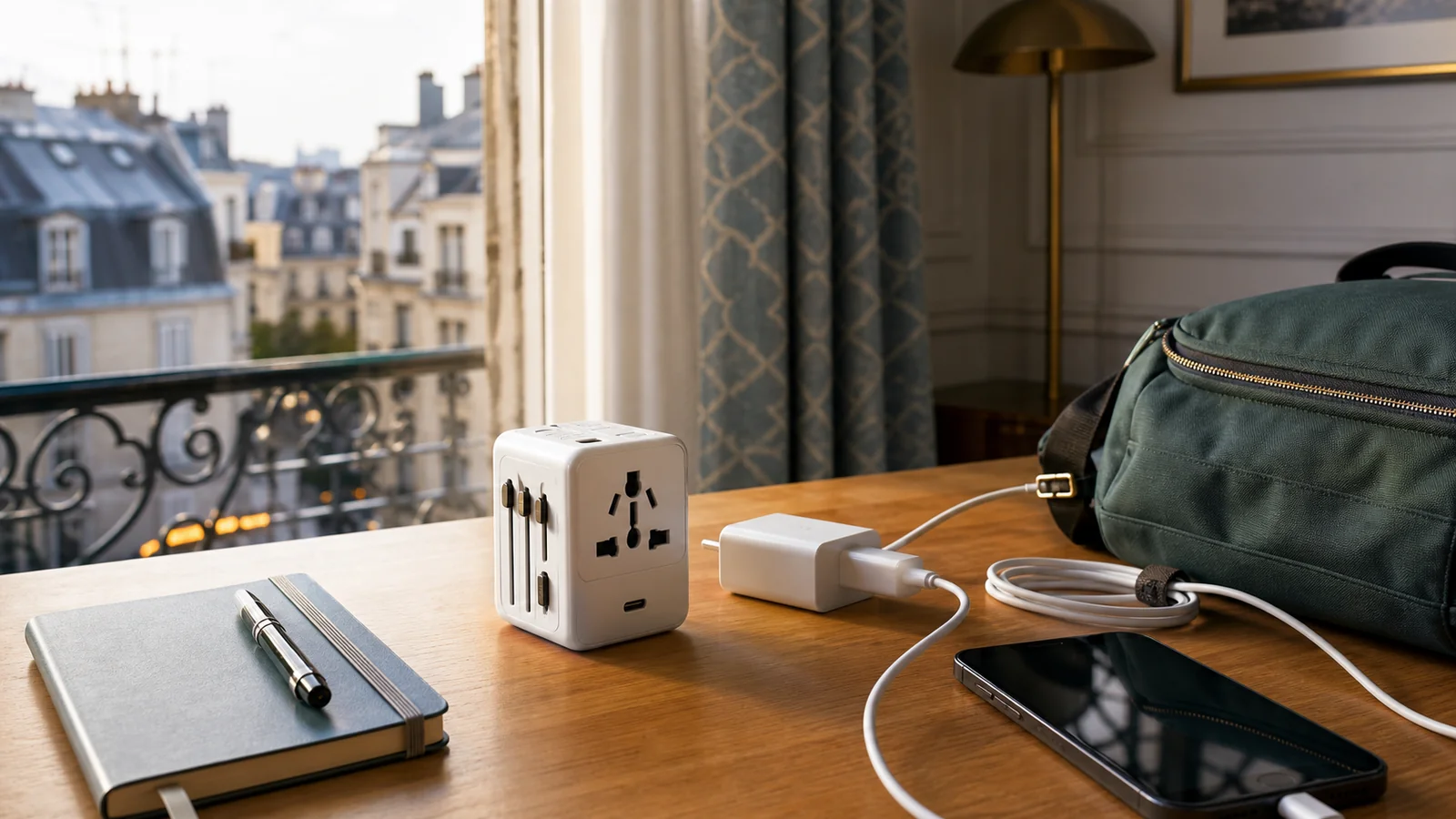
A Travel Adapter Changes Plug Shape, Not Power
A travel adapter is a small plug accessory that lets your device fit into a different wall outlet. It does not usually change the electrical voltage. That distinction matters because a laptop charger and a hair straightener do not behave the same way abroad.
For slow city travel, the point is not to pack every electrical gadget you own. It is to keep your phone charged, your camera or laptop working, and your morning calm when the only outlet is beside a narrow hotel desk.
The simplest rule is this: match the plug shape to the country, then check whether your device can handle the local voltage.
What a Travel Adapter Actually Does
Wall outlets vary by country. A U.S. plug may not fit into outlets in much of Europe, the United Kingdom, Ireland, Switzerland, Australia, or parts of Asia. A travel adapter provides the physical bridge between your plug and the local outlet.
Most adapters are passive. They do not make electricity safer, stronger, weaker, or more compatible. They only change the shape of the connection.
You may see several common plug setups:
| Destination pattern | Common plug type | What U.S. travelers usually need |
|---|---|---|
| Much of continental Europe | Type C, E, or F | Two-round-pin Europe adapter |
| United Kingdom and Ireland | Type G | Three-rectangular-pin UK adapter |
| Switzerland | Type J | Switzerland-compatible adapter |
| Italy | Type C, F, or L | Europe adapter plus check for Type L |
| Australia and New Zealand | Type I | Angled-pin adapter |
Country rules can vary by building and region, so check your exact destinations before packing. Older hotels and guesthouses may also have fewer outlets than modern apartments.
Adapter vs Converter vs USB Charger
These three items are easy to confuse.
| Item | What it does | When you need it |
|---|---|---|
| Travel adapter | Changes plug shape | Your plug does not fit the wall outlet |
| Voltage converter | Changes electrical voltage | Your device is not dual voltage |
| USB charger | Charges USB devices from the wall | You want to charge phones, earbuds, or tablets directly |
Many modern phone, tablet, camera, and laptop chargers are dual voltage. Their label often says something like “Input: 100-240V.” If you see that range, the charger can usually handle common household voltage in both North America and Europe, and you mainly need the correct plug adapter.
Do not assume every device is dual voltage. Heat tools, electric razors, older chargers, and small appliances may be single voltage. If the label only lists 110-120V and you plug it into a 220-240V outlet with a simple adapter, you can damage the device or create a safety risk.
Step 1: Check the Label on Each Device
Before you buy anything, gather the items you actually plan to bring. Look for tiny print on the charger brick, power supply, or device body.
You are looking for the input line:
100-240V: usually works internationally with the right adapter110-120V: may need a voltage converter in 220-240V countries220-240V: may not be right for North American outlets50/60Hz: frequency range, often listed near voltage
If the label is worn off or unclear, search the manufacturer page for the exact model. Do not guess with high-heat devices. If you can avoid packing a hair dryer, steamer, or straightener, your bag and your electrical worries both get lighter.
Step 2: Match Adapters to Your Route
A one-city trip is easy. A multi-country route needs a little more thought.
For a classic western Europe route, a compact Type C/E/F compatible adapter may cover many stops, but it will not cover the United Kingdom or Ireland. Switzerland and Italy can also require closer checking, especially in older properties.
If your itinerary crosses several plug regions, choose one of these approaches:
- Pack one compact adapter for each region.
- Bring a universal adapter if size and weight are acceptable.
- Use a USB-C wall charger with interchangeable plugs.
- Choose accommodation with USB outlets only as a bonus, not a guarantee.
If you are planning a longer route, keep your adapter in the same pouch as your passport or charging cable. The thing you need first is usually the thing most likely to hide at the bottom of the bag.
Step 3: Avoid Overloading One Outlet
Travel adapters are not magic power strips. A cheap adapter plus a crowded outlet plus several high-draw devices is a bad combination.
For city travel, a safer charging setup is usually:
- One reliable wall adapter for the local outlet.
- One multi-port USB charger from a known brand.
- Short cables for your main devices.
- No high-heat appliances unless they are truly travel-ready.
Charge slowly when you are in the room. Avoid leaving unfamiliar electrical gear running while you sleep or while you are out wandering. It is not glamorous advice, but it keeps the trip boring in the best way.
Step 4: Pack for the First Night
The most annoying adapter problem happens after a long arrival day, when your phone is low and your adapter is somewhere inside a packed bag.
Pack a small arrival pouch with:
- Travel adapter for the first country
- Phone cable
- Backup battery
- Printed or offline accommodation address
- SIM tool or eSIM setup notes
- Earbuds if you use them for navigation
This is especially useful if your first night is in a small hotel, old apartment, or guesthouse where the outlet is not near the bed. A little preparation keeps the evening from becoming a treasure hunt.
For a broader light-packing setup, our guide to best budget travel backpacks covers what to look for when you want one bag that still handles city walking well.
Common Mistakes to Avoid
The biggest mistake is buying a universal adapter and assuming the problem is solved. Universal models can be useful, but they still may not convert voltage, may be bulky in loose wall sockets, and may block neighboring outlets.
Other common mistakes include:
- Bringing only USB-A cables when your charger is USB-C.
- Forgetting that the UK and continental Europe use different plugs.
- Packing high-heat appliances without checking voltage.
- Leaving the adapter in checked luggage.
- Buying an adapter at the airport when you are tired and rushed.
A small checklist at home beats an expensive airport shelf.
FAQ
Do I need a travel adapter for Europe?
Usually, yes, if you are traveling from the United States and your plug does not match local outlets. Much of continental Europe uses round-pin plugs, while the United Kingdom and Ireland use a different three-pin plug.
Is a travel adapter the same as a voltage converter?
No. A travel adapter changes the plug shape. A voltage converter changes voltage. Many modern chargers are dual voltage, but some appliances are not, so check the label before using them abroad.
Can I plug my iPhone or laptop into a travel adapter?
Often, yes, because many phone and laptop chargers accept 100-240V input. Check the charger label first. If it lists 100-240V, you usually need only the correct plug adapter for the destination.
Should I buy a universal adapter or separate country adapters?
For one or two countries, separate compact adapters can be smaller and simpler. For longer routes across several plug regions, a universal adapter can be convenient if it is well built and not too bulky.
The Bottom Line
A travel adapter is a shape changer, not a power fixer. Once you understand that, packing gets easier. Check your device labels, match the plug to your first destination, keep the adapter handy on arrival, and leave high-heat appliances behind unless you know they are built for travel.
The reward is small but real: your phone charges, your map works, and your first morning in a new city starts with coffee instead of cable math.
You might also like

Travel Tea: How to Pack and Brew Calmly
Pack travel tea without fuss by choosing the right leaves, tools, water routine, and airport-friendly setup.

Travel Trailer Furnace Repair: Safe First Checks
Troubleshoot a travel trailer furnace safely with basic checks, warning signs, and clear rules for calling an RV technician.

Student Air Travel Discounts: How to Compare Them
Compare student air travel discounts by checking eligibility, total fare, baggage, flexibility, routes, and booking rules.