Travel Brochure: How to Use One for Slow Trips
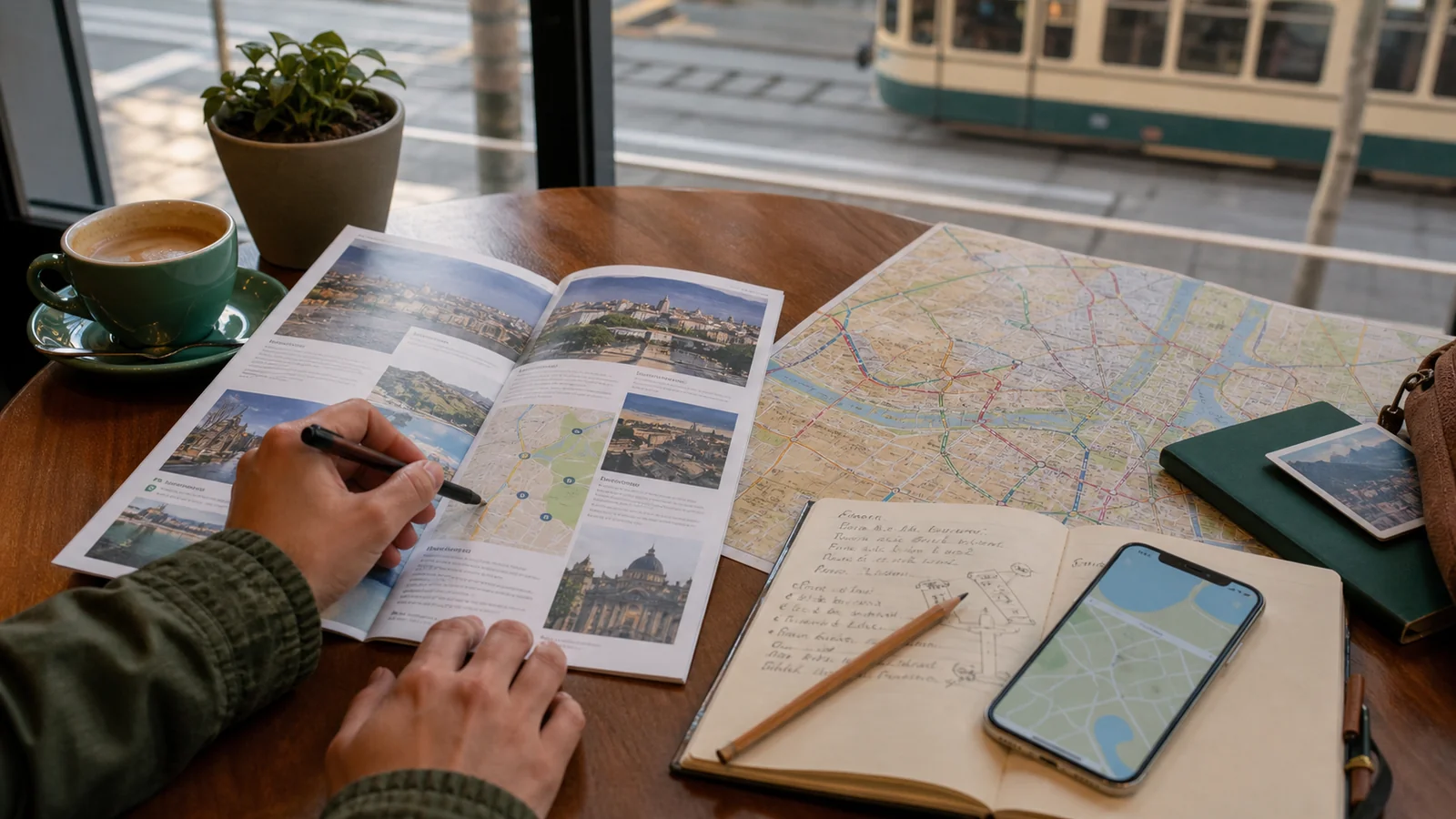
A Travel Brochure Can Still Be Useful
A travel brochure may sound old-fashioned beside maps, short videos, booking apps, and endless saved posts. But a good brochure or visitor guide can still help you understand a place quickly. It shows what the city wants travelers to notice, which neighborhoods are grouped together, what events shape the year, and how official tourism information describes the basics.
The trick is not to treat a travel brochure as a fixed itinerary. Treat it as a first layer. It can help you choose a neighborhood, make a loose list, spot transit clues, and avoid planning the whole trip around one over-polished attraction photo.
For slow travel, we use brochures as orientation tools. They are best when they help you ask better questions: Where does the day want to start? Which area rewards wandering? What can be skipped? What looks good only because the photo is doing heavy lifting?
What Counts as a Travel Brochure Now
The word “brochure” covers more than a folded paper leaflet. Many official tourism boards now publish digital visitor guides, downloadable PDFs, printed guides by mail, themed maps, neighborhood pages, event calendars, and short itinerary cards.
Common formats include:
- Printed visitor guides
- Downloadable city guides
- Neighborhood maps
- Regional road trip brochures
- Museum or attraction leaflets
- Food trail maps
- Public transit visitor maps
- Seasonal event guides
- Hotel lobby rack cards
- Airport or station visitor packets
Each format has a different job. A city visitor guide gives broad orientation. A neighborhood map helps with walking. A restaurant brochure may be more promotional. An event guide can explain timing better than a generic article.
Step 1: Start With the Source
Before you trust a brochure, ask who made it. Official tourism boards, city visitor bureaus, national park services, transit agencies, museums, and cultural institutions usually have a different purpose than a single hotel, tour company, or attraction.
| Source | What it is good for | What to watch |
|---|---|---|
| Tourism board | Broad overview, neighborhoods, official events | May favor popular attractions |
| Transit agency | Routes, fare basics, accessibility notes | May not explain visitor context |
| Museum or attraction | Hours, exhibits, visitor rules | Naturally promotes itself |
| Hotel or tour company | Nearby ideas, packages, convenience | May steer you toward partners |
| Regional road-trip guide | Scenic routes, towns, seasonal notes | Driving distances can be optimistic |
| Food or shopping map | Local clusters and specialties | Paid placement may shape listings |
This does not mean promotional brochures are useless. It means you should know what they are trying to do.
Step 2: Read the Map Before the Headlines
Most travelers start with the biggest photos. Start with the map instead.
Look for:
- Where neighborhoods sit in relation to each other
- Rivers, hills, parks, waterfronts, or rail lines
- Station locations
- Walking distances that look realistic
- Attraction clusters
- Edge areas that may be quieter
- Roads or barriers that make a short distance awkward
A brochure map is often simplified, but it shows how the destination presents itself. If three places are grouped together, they may make a natural half-day. If one attraction sits far outside the main cluster, it deserves a separate decision.
Then compare the brochure map with a live map. This catches scale, transit, closures, hills, and the difference between “near” and actually walkable.
Step 3: Circle Neighborhoods, Not Just Attractions
Attractions are easy to list. Neighborhoods shape the trip.
When reading a travel brochure, mark areas that sound like they support the kind of day you want:
- Morning cafes and bakeries
- Bookstores, markets, or small shops
- Waterfront walks
- Transit access
- Parks or shaded routes
- Museums close together
- Independent restaurants
- Low-pressure evening options
- A good bad-weather backup
For a slower city trip, two or three neighborhoods are often more useful than fifteen attractions. You can wander, pause, change your mind, and still feel like the day had shape.
If you are also choosing lodging, our guide to travel inn city stays can help you connect brochure neighborhoods with sleep, transit, noise, and late arrival details.
Step 4: Separate Inspiration From Logistics
A brochure mixes mood and information. You need both, but they are not the same.
Inspiration includes:
- Photos
- Short descriptions
- Suggested experiences
- Seasonal themes
- “Don’t miss” lists
- Food or culture highlights
Logistics include:
- Opening days
- Reservation needs
- Transit access
- Accessibility information
- Neighborhood location
- Seasonal closures
- Visitor center contacts
- Ticketing rules
Use inspiration to build interest. Use logistics to protect the day. A beautiful market photo is not enough if the market only runs on Saturdays and you arrive Monday.
Step 5: Build a Loose Shortlist
Do not turn the brochure into a checklist. Choose a small set of anchors and options.
Try this structure:
| Planning layer | How many to choose | Example |
|---|---|---|
| Main neighborhood | 1 per day | Old town, arts district, waterfront |
| Anchor stop | 1 per day | Museum, market, viewpoint |
| Soft options | 2 to 4 | Cafe, bookshop, side street, park |
| Weather backup | 1 | Gallery, covered market, library |
| Evening fallback | 1 | Simple dinner area near transit |
This gives the day a shape without squeezing out discovery. If the first neighborhood is better than expected, stay. If the weather turns, use the backup. If you are tired, skip the far attraction without feeling like the plan collapsed.
Step 6: Check What the Brochure Leaves Out
Brochures are selective. That is their job. Your job is to notice what is missing.
Check for:
- Public transit details
- Exact opening hours
- Reservation requirements
- Current construction or closures
- Neighborhood safety at night
- Accessibility details
- Actual walking distances
- Local holidays
- Heat, snow, rain, or wildfire season
- Whether photos show peak season only
Official visitor guides may be accurate when published but still dated by the time you travel. Use them for orientation, then confirm key details with current official pages.
This is especially important for travel documents and entry rules. If your trip crosses borders, use official government or airline sources for requirements. A brochure is not the right place to verify visa, passport, or health-document details.
Step 7: Use Brochures to Find Underrated Stops
The obvious attractions will appear everywhere. The smaller clues are often more useful.
Look for:
- Neighborhood walking maps
- Local market days
- Small museums
- Public gardens
- Ferry routes
- Libraries or cultural centers
- Scenic stairways
- Historic street grids
- Food trails that point to real districts
- Transit-connected suburbs or nearby towns
Sometimes the most useful part of a travel brochure is a tiny map inset, a one-sentence neighborhood description, or an event calendar that shows when locals already gather.
For flexible city wandering, those clues can beat a top-ten list.
Digital vs Printed Travel Brochures
Digital guides are easier to update and carry. Printed brochures are easier to mark up, spread on a table, and use when your phone battery is low. Both have a place.
| Format | Best use | Weakness |
|---|---|---|
| Digital PDF | Pre-trip planning, search, saving offline | Harder to browse casually on a small phone |
| Printed visitor guide | Big-picture planning, note-taking, hotel-room review | Can be outdated or bulky |
| Folded map | Walking orientation | Limited detail |
| Tourism website | Current events and links | Can feel scattered |
| App-based guide | Live directions and saved places | Requires battery and data |
Our favorite approach is simple: read the digital guide before the trip, save the map offline, and pick up a printed guide only if it will genuinely help on the ground.
How to Turn a Brochure Into a One-Day Plan
Here is a practical way to use one brochure without overplanning.
- Read the map and choose one walkable area.
- Pick one anchor stop in that area.
- Add two nearby soft options.
- Check transit to and from the area.
- Confirm opening hours for the anchor.
- Add one indoor backup.
- Leave one block of the day empty.
The empty block is important. It gives you room for a slow lunch, a better side street, a delayed train, or a museum that deserves more time.
If every hour is filled, the brochure has started controlling the trip. That is the moment to remove something.
Mistakes to Avoid
Travel brochures can mislead you when you use them too literally.
Avoid:
- Planning around every highlighted attraction
- Trusting simplified maps for walking time
- Assuming photos reflect the season you will visit
- Ignoring transit gaps
- Missing reservation rules
- Letting sponsored listings decide your meals
- Treating old printed hours as current
- Choosing lodging from brochure proximity alone
- Skipping local neighborhoods because they are not glossy
- Forgetting that tourism language tends to sound enthusiastic
The solution is not cynicism. It is balance. Let the brochure introduce the place, then let maps, current sources, and your own travel style refine the day.
When a Brochure Is Not Enough
Use other sources when the decision is high-stakes or time-sensitive.
Check official current sources for:
- Border entry rules
- Airline baggage and check-in rules
- Transit strikes or service changes
- Museum closures
- Weather hazards
- Road closures
- Major event crowding
- Accessibility details
- Park permits
- Reservation-only attractions
Use recent local reporting or community sources for things brochures rarely describe: construction, restaurant turnover, neighborhood changes, and how crowded a place feels outside the perfect photo.
FAQ
Are travel brochures still useful?
Yes. They are useful for orientation, maps, neighborhoods, seasonal ideas, and official visitor context. Use them as a starting point, then verify current details.
Where can I get a travel brochure?
Look at official tourism websites, visitor centers, airports, train stations, hotels, museums, and destination marketing organizations. Many now offer digital visitor guides.
Should I plan my whole trip from a brochure?
No. A brochure is best for choosing areas, ideas, and loose anchors. Confirm hours, transit, reservations, and weather with current sources before you rely on them.
Are digital travel brochures better than printed ones?
Digital brochures are easier to search and save. Printed brochures are better for browsing, marking up, and sharing at a table. Many travelers benefit from using both lightly.
How do I know if a brochure is trustworthy?
Check who made it, when it was published, whether it links to current official pages, and whether it clearly separates general inspiration from practical details.
The Bottom Line
A travel brochure can still be a smart planning tool when you use it gently. Start with the map, choose neighborhoods before attractions, separate inspiration from logistics, and build a short list instead of a packed itinerary.
The best brochure does not tell you exactly what to do. It helps you understand enough to wander well.
You might also like

Travel Inn: How to Choose a Simple City Stay
Use a practical travel inn checklist for location, fees, safety, noise, and comfort before booking a basic city stay.
Travel Agent Near Me: How to Choose One Well
Find out when a local travel agent is useful, what to ask, and how to avoid pressure, vague fees, and bad-fit planning.

Travel Tea: How to Pack and Brew Calmly
Pack travel tea without fuss by choosing the right leaves, tools, water routine, and airport-friendly setup.